
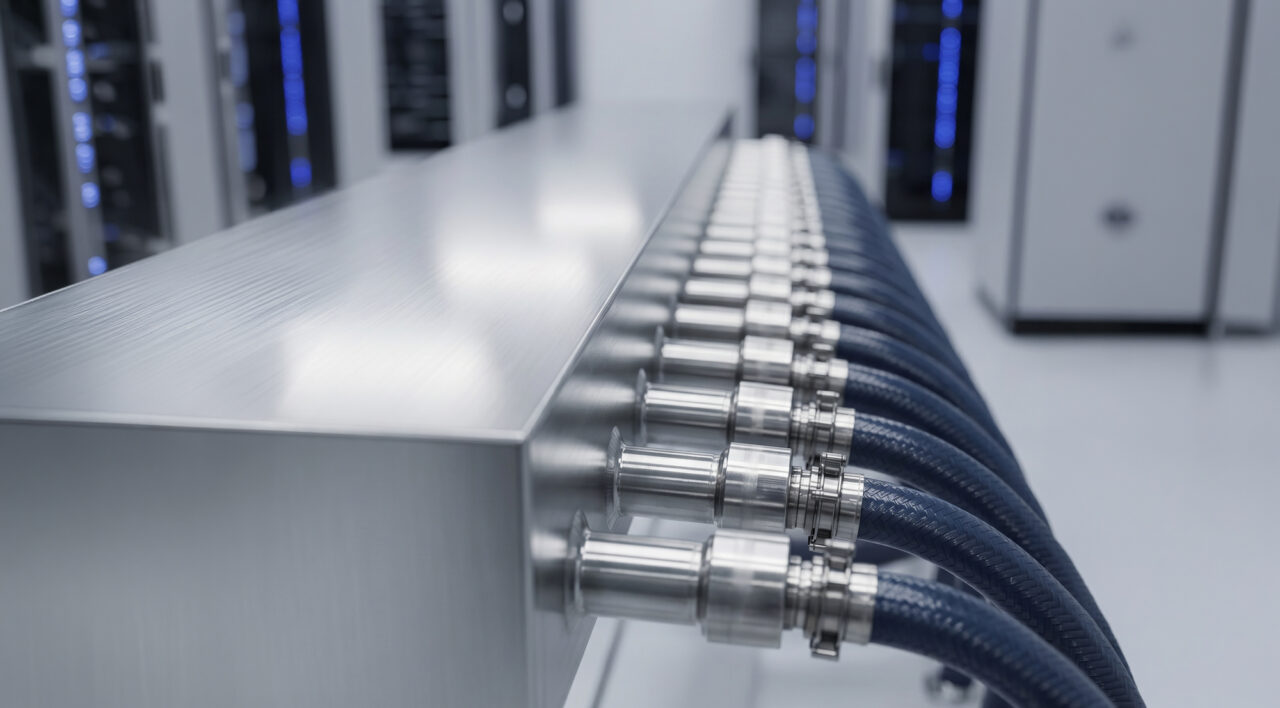
Our Business Development Manager, Tommi Purtilo, has written a blog post on the evolving role of stainless steel manifold tubes in modern data center cooling systems, and why their importance is rapidly growing as thermal demands increase.
As AI and high-performance computing continue to push thermal loads to new extremes, data center cooling is undergoing a fundamental shift. Traditional air cooling is no longer sufficient in many high-density environments, making liquid cooling a necessity rather than an option.
At the center of these systems is a critical but often overlooked component: the coolant distribution manifold. Its performance directly impacts reliability, efficiency, and the overall lifespan of the data center infrastructure.
The growing role of liquid cooling infrastructure
Modern server racks generate significantly higher heat loads than before. To manage this effectively, liquid cooling systems must deliver consistent, leak-free performance over long operational lifetimes.
This places new demands on manifold structures:
- Absolute reliability with zero tolerance for leakage
- Long-term corrosion resistance in controlled but demanding environments
- Efficient integration into increasingly dense rack configurations
Stainless steel manifold tubes are uniquely positioned to meet these requirements.
Designed for reliability and lifetime performance
When cooling is mission-critical, material selection becomes a key engineering decision. Stainless steel offers a combination of durability, corrosion resistance, and formability that ensures cost effectiveness and long service life even under continuous operation.
Our manifold tubes are manufactured using high-precision laser welding, producing exceptionally strong and clean weld seams. This minimizes the risk of defects and ensures reliable, leak-free performance throughout the lifecycle of the system.
A virtually spatter-free internal surface reduces the need for post-processing. This supports stable coolant flow characteristics and reduces the risk of disturbances within the system.
Why rectangular profiles outperform traditional solutions
While round tubes have traditionally been used in piping systems, rectangular and square stainless steel hollow sections offer clear advantages in data center applications.
These profiles enable:
- Flat surfaces for easy mounting of connectors, sensors, and fittings
- Efficient integration into in-rack manifold systems
- Better space utilization in high-density rack environments
With a wide range of dimensions available, such as 60 × 35 × 3 and 78 × 45 × 3, manifold designs can be optimized for both performance and spatial efficiency.
Material options for demanding environments
Different cooling environments require different material properties. Stainless steel grades can be selected to match specific performance requirements:
- EN 1.4301 / 1.4307 (AISI 304 / 304L): versatile and widely used, offering excellent corrosion resistance and formability
- EN 1.4404 (AISI 316L): enhanced resistance to chlorides and more aggressive environments
Precision manufacturing for seamless integration
In data center environments, precision is critical. Components must fit perfectly to reliable operation.
Our roll forming process delivers superior dimensional accuracy, enabling the efficient machining of connectors and other features into the tubes. 304L and 316L materials offer excellent weldability. Together all this makes rectangular or square stainless steel tube a most cost efficient basis for the fabrication of data center manifolds.
Building the backbone of next-generation cooling systems
As data centers continue to evolve, the importance of robust and efficient cooling infrastructure will only grow. Manifold systems must not only perform under demanding conditions but do so reliably over years of operation.
Stainless steel manifold tubes provide a future-proof solution, combining structural efficiency, corrosion resistance, and manufacturing precision to meet the needs of next-generation liquid cooling systems.
For engineers and designers working on modern data center platforms, the question is no longer whether to optimize cooling infrastructure, but how far that optimization can go.
The writer
Tommi Purtilo
Business Development ManagerEnergy Industry, Hollow sections & profilesStalatube Oy (Finland)
Technical support