
ESG is at the core of Stalatube’s strategy. Our ambition is to be the world’s leading manufacturer of high-strength stainless steel tubes, operating responsibly and with a strong customer focus. This is reflected not only in our strategy, but also in our daily operations related to product development, investments, people, and collaboration with stakeholders.
Our growth targets towards 2030 are driven by megatrends such as the green transition, increasing ESG requirements, and growing customer demand for lighter, more durable, and lifecycle-efficient solutions. Our high-strength products help customers reduce their own carbon footprint. By enabling lighter structures, reducing material use, and extending product lifecycles, we support our customers in creating a positive carbon handprint. In this way, sustainable business creates added value for both our customers and society.
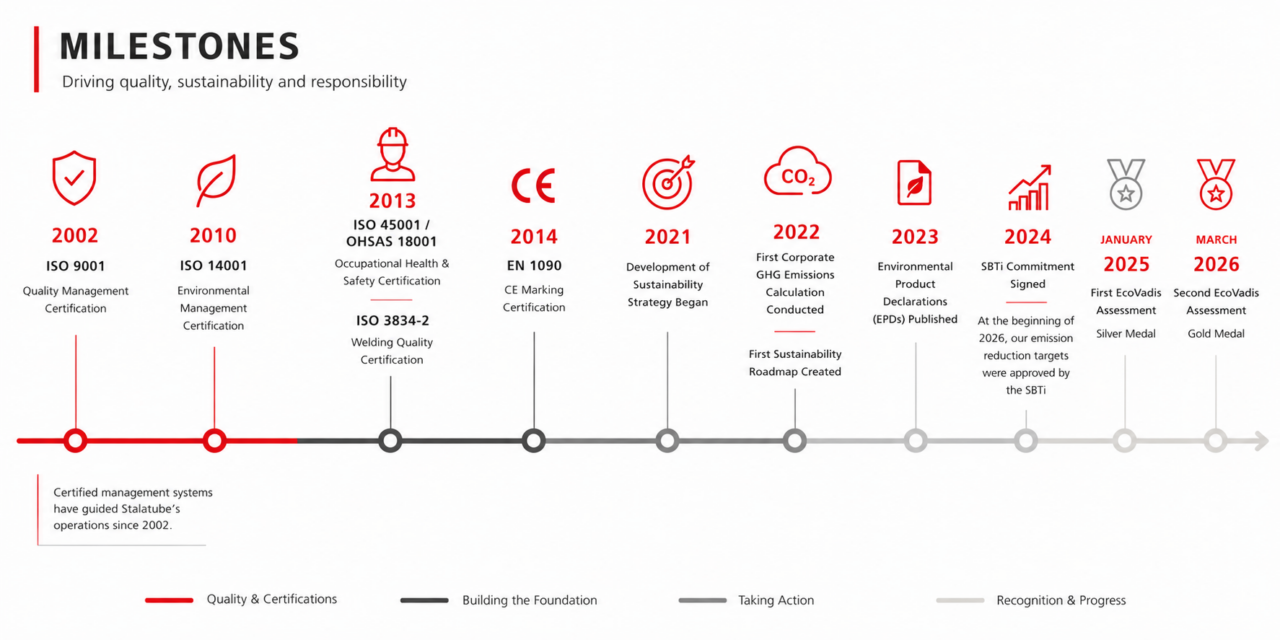
Our sustainability work is built on a certified management system. Our ISO 9001 quality management certification dates back to 2002, ISO 14001 environmental certification to 2010, and ISO 45001 occupational health and safety certification to 2013. For us, these are not merely compliance requirements, but practical tools for continuous improvement.
The development of our management systems and environmental work began gradually even before the official certifications. Prior to ISO 9001 certification, operational development was supported through self-assessments and internal audits. In environmental management, we utilized an environmental handbook as well as internal and external evaluations to identify environmental impacts and areas for improvement already before ISO 14001 certification. The certifications were therefore a natural continuation of work that was already underway and a way to make our established practices visible and comparable against international standards.
The development of our sustainability strategy began in 2021 with a current-state analysis and assessment, with ESG clearly defined as the strategic framework. The following year, we created our first sustainability roadmap outlining actions and targets through to 2030. This roadmap is updated annually.
Reducing climate impacts is one of the key priorities of our sustainability work. We have calculated our corporate-level GHG emissions in accordance with the GHG Protocol for five consecutive years. Emissions calculations alone do not reduce emissions, but they have given us valuable insight into where our emissions originate. This understanding, combined with continuous development work, has enabled us to reduce our emissions by more than 50% since our first calculation.
At the beginning of this year, we took another important step forward when our company’s emission reduction targets were officially approved by the Science Based Targets initiative (SBTi). We first committed to setting science-based targets in 2024. This approval confirms that our climate targets are aligned with climate science and the goals of the Paris Agreement, and that we are committed to reducing emissions through measurable, science-based actions.
The impact of our sustainability work is also reflected in external assessments. We have now received EcoVadis ratings for two consecutive years. Our first rating last year achieved Silver level, while our latest rating this year improved to Gold level. This demonstrates both continuous development and the stronger integration of sustainability into our business operations.
Another significant milestone was reached this year with the publication of our first sustainability report aligned with the ESRS standards. Sustainability reporting increases transparency brings structure to sustainability work and helps both us and our stakeholders better understand the impacts of our operations on the environment, people, and society.
Sustainability is not only about strategies, calculations, or reporting. It should be reflected in everyday actions in production, decision-making, and collaboration. It can be seen in energy-efficiency investments, reducing material waste, the high share of recycled steel, the development of safety culture, and employee engagement. We strongly believe that no one builds sustainability alone. That is why we work closely together with customers, suppliers, and other stakeholders. Together, we can create greater impact and build a more sustainable future. One step at a time.
For us, sustainability is a journey, not a destination.
The writer
Tanja Pakarinen
EQHS & Sustainability Engineer