
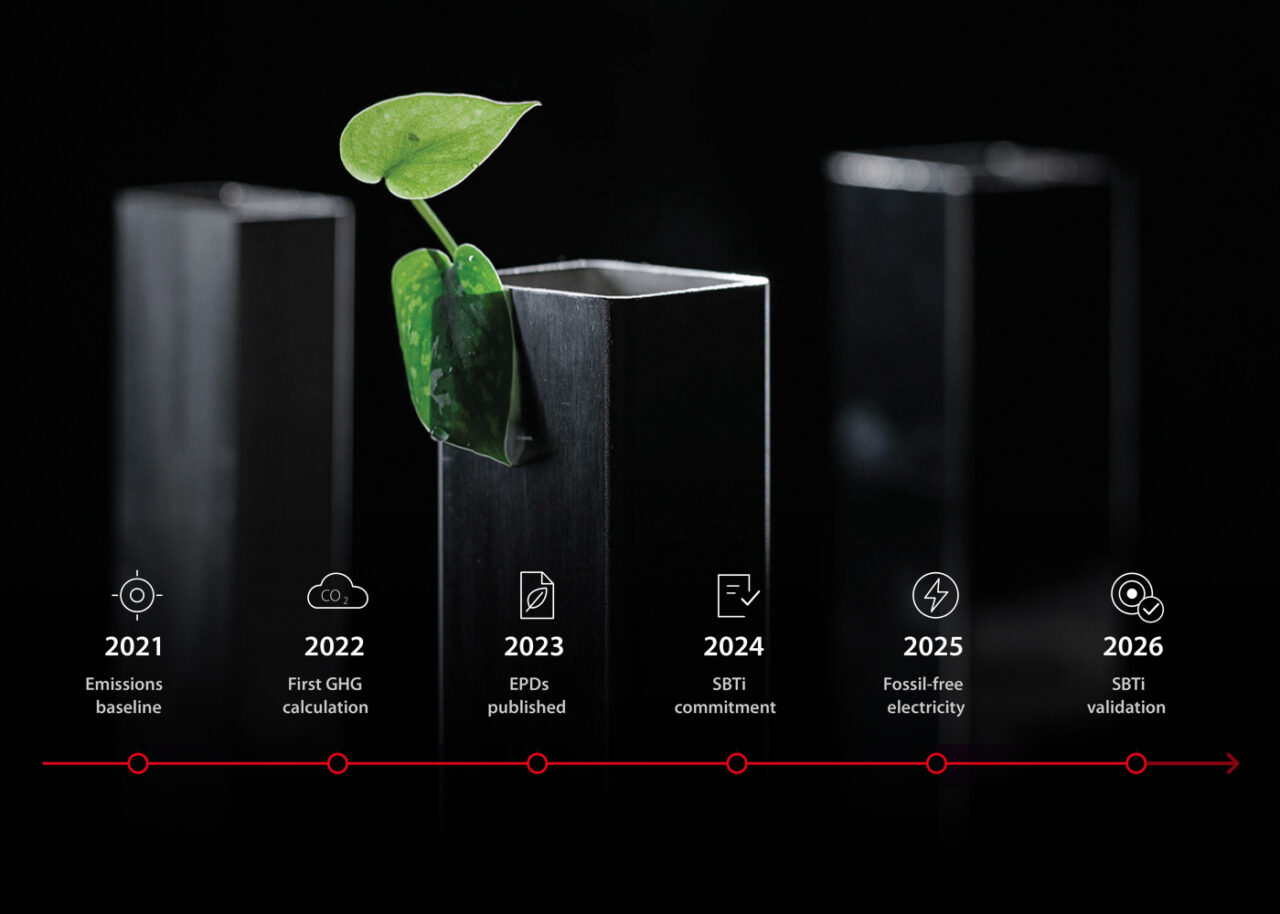
At Stalatube, climate action is an integral part of our strategy and guides how we develop our operations, procurement and products. Our work combines science-based targets with practical improvements across the value chain, from raw materials and manufacturing to the stainless steel solutions we provide for our customers.
Building on emissions data
Understanding our emissions is the foundation of our climate work. We calculate our corporate greenhouse gas emissions across Scopes 1, 2 and 3 in accordance with the GHG Protocol, using 2021 as the baseline for our reduction targets. By developing our calculations, we strengthen our understanding of where emissions originate and where reduction measures can have the greatest impact.
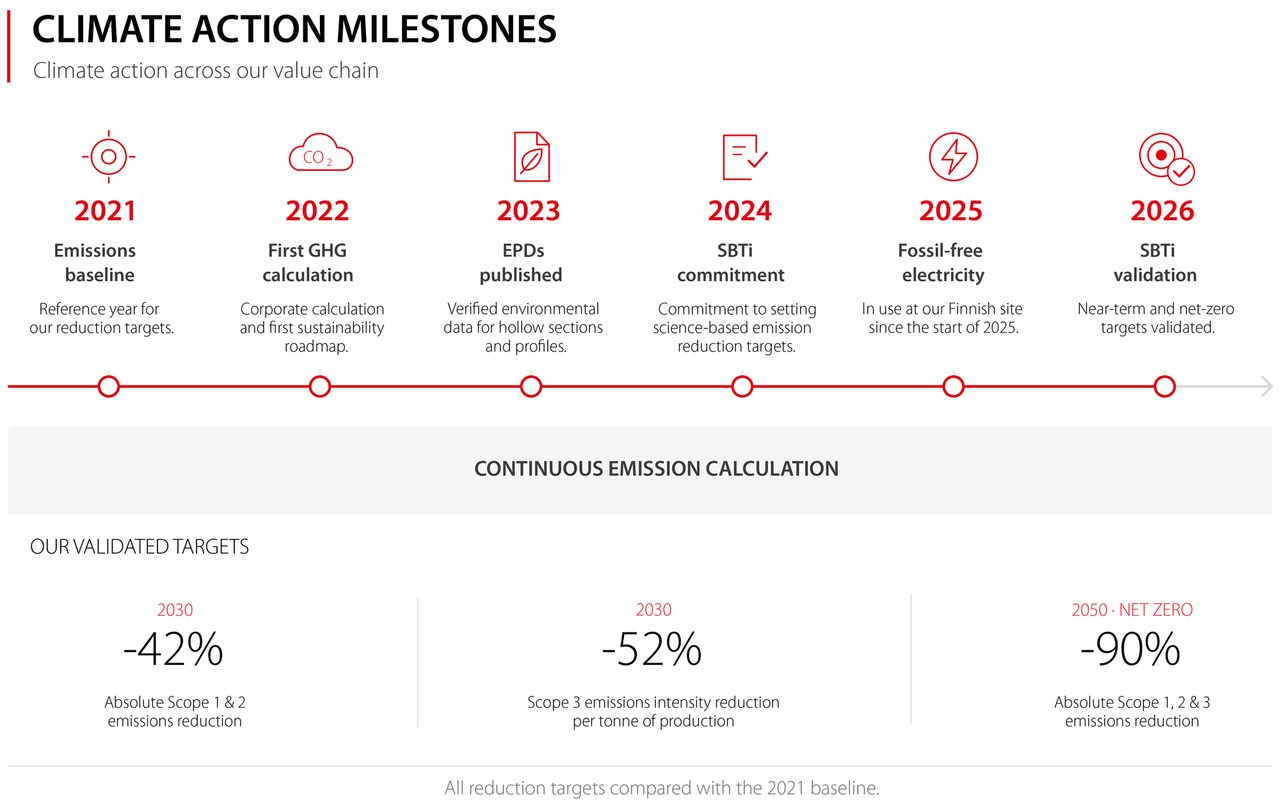
Our first sustainability roadmap was created in 2022 and is updated annually. The publication of Environmental Product Declarations (EPDs) in 2023 added verified product-level information on the environmental impacts of our stainless steel hollow sections and profiles. This data also supports our customers in assessing the impacts of their material choices.
Science-based targets for 2030 and 2050
We committed to the Science Based Targets initiative (SBTi) in 2024. Since then, both our near-term and net-zero targets have been validated by SBTi, confirming their alignment with climate science.
Our targets are to:
- Reduce absolute Scope 1 and 2 emissions by 42% by 2030.
- Reduce Scope 3 emissions intensity by 52% per tonne of production by 2030.
- Reduce absolute Scope 1, 2 and 3 emissions by 90% by 2050.
All reductions are measured against our 2021 baseline. These targets guide our work towards net-zero greenhouse gas emissions across our value chain by 2050.
Turning targets into practical action
Our plan is to connect these targets with practical measures in our operations and supply chain. These measures will include, for example, improving energy and material efficiency and reducing emissions from raw materials and transportation.
In our own operations, we continuously improve energy efficiency and increase the use of fossil-free energy. Our Finnish site has used fossil-free electricity since the beginning of 2025. Investments in solar power, heat recovery, heat pumps and intelligent ventilation have further improved the energy efficiency of our production.
A significant share of our climate impact originates in the value chain, particularly from raw materials and transportation. We therefore work with our suppliers to reduce the emissions intensity of the materials we purchase and explore lower-emission sourcing and transport solutions. Cooperation across the supply chain is essential to achieving our targets.
Supporting our customers’ climate goals
Our climate work also extends to the solutions we develop for our customers. By combining high-strength stainless steel with structural optimisation, we help create lighter, durable and material-efficient structures.
Using less material while maintaining the required performance can help customers reduce material consumption and lower the carbon footprint of their applications. Our aim is to make these benefits part of everyday engineering and material decisions.
Ask us more
Tanja Pakarinen
EQHS & Sustainability Engineer